Broadband Master Plan

The City of Lincoln is committed to providing fast, reliable internet access for residents, businesses, and organizations throughout the community. To support this goal, the City launched the Broadband Master Plan, an initiative focused on improving internet access and expanding broadband infrastructure. As part of this effort, the City assessed existing infrastructure, identified gaps, and explored opportunities for improvement.

Key Goals

  • Reducing the Digital Divide: We want to ensure everyone in our community, including underserved and unserved areas, can access reliable and affordable internet.
  • Improving Fiber Infrastructure: Enacting our plan will expand high-speed internet connections in commercial areas to foster economic development and job creation.
  • Enhancing Public Services:  Public facilities and businesses need access to high-speed internet access to operate efficiently.
  • Supporting Community Growth: High-speed, reliable internet access is essential for Lincoln’s economic development, education, healthcare, and public safety.

Report Findings

Lincoln has many city-owned assets that could help expand broadband, including water and sewer lines, streetlights, utility poles, and traffic signals. These assets create strong opportunities for both underground fiber and wireless service, especially in areas that are currently underserved.

To make this possible, the city would need targeted upgrades and better coordination across existing infrastructure. With strategic investment, these improvements could support faster internet access, strengthen public safety and traffic systems, and help close the digital divide for residents and businesses.
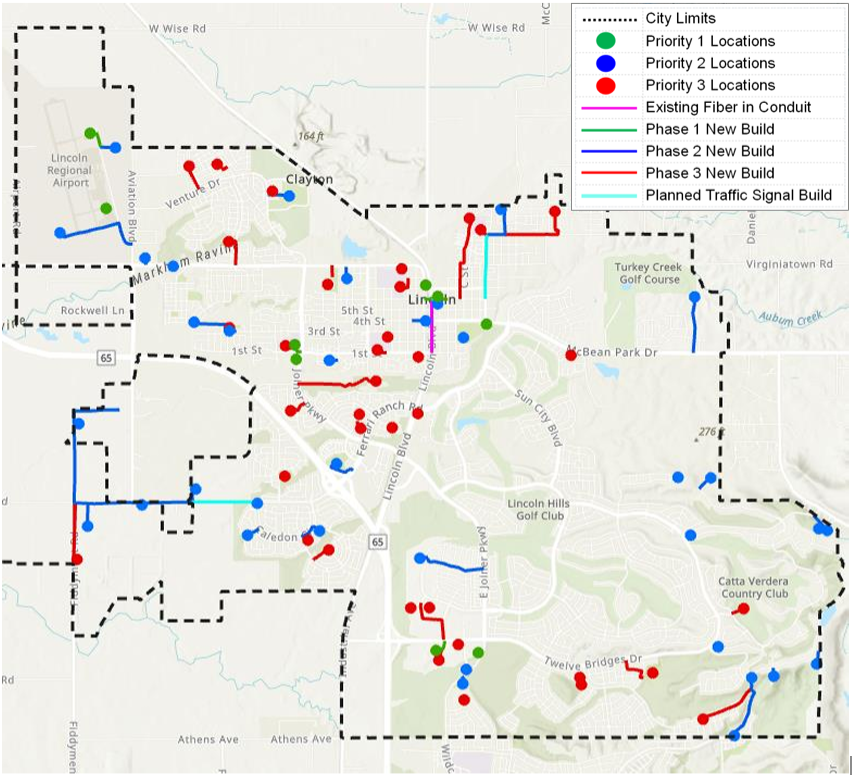
Lincoln can reduce future broadband costs by including broadband planning in capital improvement projects. Work such as road widening and water system upgrades often requires excavation, creating a cost-effective opportunity to install conduit or prepare for future broadband expansion at the same time.

If broadband is not considered during these projects, the city may miss opportunities and face higher construction costs later. Planning ahead through the Capital Improvement Program can help Lincoln improve connectivity, support future technology needs, and make better use of public investment.

Lincoln can support future growth by including broadband planning in its Specific Plans, especially in developing areas within the city’s sphere of influence. Planning for broadband early can help new growth areas, such as Village 5, be better prepared for residents, businesses, schools, and city services.

Reliable high-speed internet is an important part of economic development and quality of life. By adding broadband provisions to planning documents, Lincoln can encourage equitable growth, improve access to digital services, and better position the city for long-term development.

A long-term, phased approach to building city-owned broadband infrastructure could be the most cost-effective option for Lincoln and would give the city more control over critical network assets. A municipal fiber backbone could support public-private partnerships while helping the city expand service in underserved areas and support public safety, smart city technology, and municipal operations.

City-owned infrastructure can also create future flexibility and potential revenue through leasing or shared use agreements. To move forward, Lincoln would need to evaluate feasibility, test pilot projects, and identify funding sources such as grants, partnerships, and city investments.

Public-private partnerships can help Lincoln expand broadband more quickly and reduce funding challenges. By working with broadband providers and wireless carriers, the city can share costs, attract private investment, and make better use of existing city-owned assets such as streetlights and utility poles.

These partnerships could help extend service to underserved areas, support technologies like 5G and fixed wireless access, and create revenue that can be reinvested into infrastructure improvements. A strong partnership approach can help Lincoln advance its broadband goals in a cost-effective and equitable way.

Lincoln is relatively well served by broadband compared with many nearby communities, and fiber internet is available in a significant portion of the city. However, fiber access is still limited in some areas, and many residents and businesses have few provider options, with much of the city relying on a cable monopoly.

This means that while broadband service is generally available, competition and consumer choice remain limited. Expanding fiber options could improve service, increase reliability, and give residents and businesses more choices.

Lincoln’s broadband market is more varied than the typical two-provider model. Multiple companies play important roles across cable, DSL, and fiber service, which creates a different competitive landscape than many communities.

At the same time, provider choice is still limited in some areas. For example, Lincoln Crossing benefits from affordable fiber service included through HOA dues, which helps ensure strong connectivity for residents, but it also means households in that area have limited service options. Overall, Lincoln has a broader mix of providers than usual, but competition and customer choice are not consistent citywide.

While Lincoln has strong wired broadband coverage, 5G wireless coverage is much more limited. Coverage is present near major corridors such as Highway 65, Lincoln Boulevard, and Joiner Parkway, but it becomes weaker farther from those areas and toward the city’s outskirts.

Some eastern residential neighborhoods, including areas near the golf course communities, appear to have little or no 5G coverage. This highlights a gap in wireless connectivity in parts of the city.

Concept Design

Lincoln’s conceptual network design would connect 80 city facilities and community institutions through a citywide ring network using existing private fiber infrastructure. This would allow the city to expand broadband in a strategic and coordinated way. By linking these sites, Lincoln could improve access to services, support community needs, increase operational efficiency, and strengthen critical city functions.

Frequently Asked Questions

Broadband is high-speed internet access that can be delivered through different types of technologies like fiber optics, wireless, cable, among others.

Our end goal is to provide the entire Lincoln community with reliable, high-speed internet, including certain areas in the city that have never had the infrastructure to offer internet at all.

The plan’s goal is to improve the overall quality of life for everyone, identify areas lacking internet access, and support job-creating businesses. The plan will foster growth, ensuring we stay competitive as a city, and will help make our community stronger and more connected.

The plan is funded by the American Recovery Plan Act (ARPA) funds that have been earmarked for broadband. The buildout of the plan will be completed using grants and funds from development or other related building permits.

Any necessary construction to improve broadband infrastructure will be communicated in advance. Most upgrades will involve existing infrastructure, so disruptions should be minimal.

The city will not be running the internet service itself; instead, we are working with ENTRUST to find the best private company to manage and run the city’s publicly owned fiber internet network through a public-private partnership.

Contact Us

Broadband
City of Lincoln
600 6th Street
Lincoln, CA 95648
Phone: 916-434-3300
Email Us
Map this Location