
No, a public hearing has not been scheduled for this project. Once a hearing has been scheduled, the City is required to post a public hearing notice in the Lincoln News Messenger at least 10 days prior to the hearing date. Additionally, public notices will be mailed to property owners located within 400-feet of the project site’s property lines.
Prairie Point Telecommunications Facility
The City has received a development application for a wireless telecommunications facility (cell tower) for the Twelve Bridges area. In response to public inquiry, we’ve created a Frequently Asked Questions (FAQ) webpage to provide information about this project, as well as general information on cell towers.
The Prairie Point Wireless Telecommunications Facility Project proposes to construct and operate a facility consisting of a 60-foot stealth mono-broadleaf tower, ground equipment and associated infrastructure and improvements. The project applicant has submitted a Conditional Use Permit (CUP) application to construct the project. Preliminary project plans can be accessed here: Prairie Point. Please note that these are preliminary plans and subject to change. City staff are still in the review process for this project, and may provide comments that require changes to the site plans.
Where is the project located?
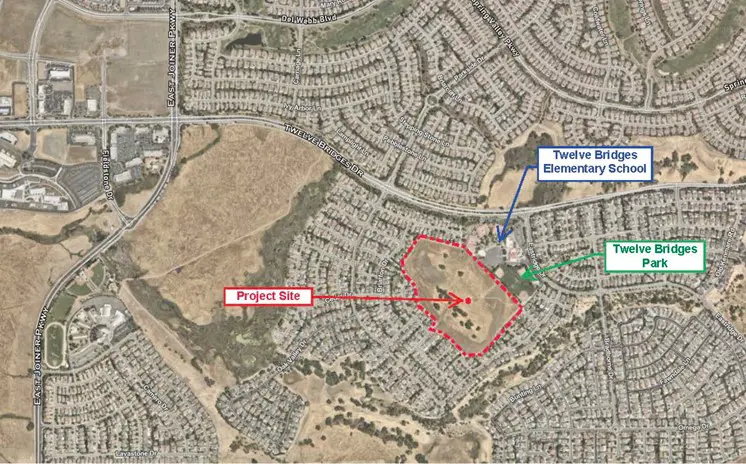
The project site is located within the Twelve Bridges community on an undeveloped parcel west of Twelve Bridges Elementary School and Twelve Bridges Park (see image below). Assessor’s Parcel Numbers 334-010-013-000 and 334-060-064.
Has a public hearing been scheduled for this project?
Was this project previously anticipated to be located at Coyote Pond Park?
No, this project was never anticipated to be constructed at Coyote Pond Park. The applicant previously named this project “Coyote Pond”, but the City requested they change the name to avoid confusion since the project site is not located at or near Coyote Pond Park. The project was subsequently named “Prairie Point.”
What is electromagnetic radiation, and is it harmful?
Electromagnetic radiation is a combination of electric and magnetic fields that move through space together as waves. There are two categories: non-ionizing and ionizing. Cell towers produce non-ionizing radiation. Other examples of non-ionizing radiation emitters include light bulbs, computers, Wi-Fi routers, cell phones, FM radio, GPS, and broadcast television. Routine exposure to non-ionizing radiation is generally perceived as harmless to humans, according to the Food and Drug Administration (FDA). Scientific consensus shows that non-ionizing radiation is not a carcinogen and, at or below the radio frequency exposure limits set by the FCC, has not been shown to cause any harm to people.
Ionizing radiation (i.e., X-ray machines, radioactive materials, nuclear fission, etc.) is considered high-energy radiation with the potential for direct cellular and DNA damage, according to the FDA. Cell towers do not emit ionizing radiation.
Who regulates cell towers, and what are the emission requirements?
Congress delegated sole authority to the Federal Communications Commission (FCC) to establish radio frequency (RF) emission and safety guidelines for wireless facilities. The wireless carriers are required to ensure that their wireless facility installations comply with the FFC’s RF limits. Local governments may check for compliance with FCC RF standards, but they cannot establish their own RF standards, whether such standards are higher, lower or even the same, nor can they reject applications for wireless facilities based on RF concerns if the facility meets the FCC’s RF standards.
The FCC regulations provide a fifty (50) times safety margin between the maximum public exposure allowed, and the level where a physiological change can be measured in a person. Wireless operators commonly operate at a fraction of the maximum permitted by the FCC because to transmit with higher power will commonly cause cell site to cell site interference.
It should also be noted that ground level exposure is much less than that if someone were close to the antenna and in its transmission path. Further information can be found on the FCC’s RF Safety and Frequently Asked Questions (FAQ) websites.
Where can I find the FCC’s guidelines related to human exposure to RF fields and cell towers?
Information can be found on the FCC's website.
Can a city deny a cell tower permit?
A city’s authority to regulate the placement and modification of cell towers is limited by the federal Telecommunications Act of 1996. When a local government receives a cell tower siting application, it must respond “within a reasonable period of time” (90 days for collocation applications and 150 days for all other applications) and must support any denial with “substantial evidence contained in a written record.” A cell service provider may, within 30 days of a denial or failure to respond, file suit against the local government.
Under the Telecommunications Act of 1996, there are five important limitations on local government when dealing with cell towers and telecommunications carriers (47 U.S.C. § 332(c)(7)(B)):
- A local government shall not unreasonably discriminate between providers of functionally equivalent services when regulating the placement, construction, and modification of cell towers.
- A local government shall not prohibit or have the effect of prohibiting the provision of service when regulating the placement, construction, and modification of cell towers.
- A local government must act on any request for authorization to place, construct, or modify a cell tower within a “reasonable period of time” after the request is filed.
- A local government must issue a written opinion explaining its decision to deny a request, which decision must be supported by “substantial evidence.”
- A local government cannot deny the placement, construction, or modification of cell towers based on the alleged “environmental effects of radio frequency emissions,” so long as the facilities comply with the FCC’s regulations on radio frequency emissions.
Cities can guide the location and design of towers (i.e., setbacks, “stealth”/concealment designs, etc.), but they cannot ban them, discriminate against providers, or deny permits based on RF emissions that comply with FCC standards.
What does the FCC say about locating cell towers near homes or schools?
RF emissions from antennas used for cellular and personal communication services (PCS) transmissions result in exposure levels on the ground that are typically thousands of times below safety limits. These safety limits were adopted by the FCC based on the recommendations of expert organizations and endorsed by agencies of the Federal Government responsible for health and safety. Therefore, there is no reason to believe such towers could be a potential health hazard to nearby residents of students.
My cell phone works fine, why do we have to allow more wireless infrastructure in Lincoln?
Federal law (47 U.S.C. 332(c)) does not allow the City to regulate “personal wireless service facilities” which includes facilities that provide both phone and data services. Federal law also does not allow for the City to consider whether the existing level of wireless coverage is adequate as part of the permitting process nor makes a distinction between the purpose of phone calls versus electronic data for the wireless technology infrastructure regulations. Per recent FCC regulations, a wireless carrier is not required to prove there is a gap in existing coverage to proceed with the installation of additional infrastructure.
What effect do cell tower sites have on property values?
Limited reliable data is available regarding the effect of small wireless facilities on property values. The following information was prepared for the City of Spokane, Washington:
The effect of cell tower sites on property values is an emotionally charged topic. Homeowners subjectively believe that a diminution in value is a given. Objective research seems to indicate otherwise, particularly as the distance from the cell site increases, and as time passes. Cell tower sites that are camouflaged have less effect on property values than non-stealthed, freestanding towers and poles. This ambiguity regarding property values leads to uncertainty for homeowners. While one homeowner may be concerned about aesthetics and health risks, another may welcome a cell tower because of improved coverage, capacity, network speed and improved cell service. Additionally, the effect on property values is fact specific and may vary depending upon the type of facility (cell tower, antenna site, monopole, etc.), along with its location, visual ramifications and the type of residential neighborhood. In any event, it is in residents’ best aesthetic interests to minimize the number of new cell towers inside the core of residential zones by encouraging collocation among providers and expedited review processes for smaller and stealthed facilities. Further, there has been anecdotal discussion that where residences do not have good cell phone reception, this could negatively impact potential buyers’ willingness to purchase homes in that area. The ability to receive and initiate phone calls, make emergency calls, and communicate with e-mails and text messages are services that people have come to expect.
For questions, please contact the Planning Division at:
Email: prairiepoint@lincolnca.gov
Contact Us
Community Development
Planning
City of Lincoln
600 6th Street
Lincoln, CA 95648
Phone: 916-434-3370
Email Planning Division
Map this Location


